

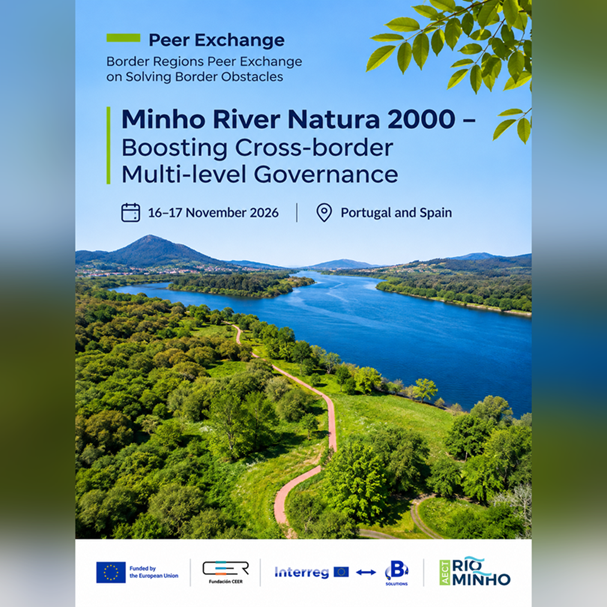
12 Nov Rio Minho cross-border territory launches European exchange programme on the challenges facing border regions
EGTC Rio Minho will host, on 16 and 17 November, the first of ten visits under a European Commission programme addressing obstacles to cooperation between border regions. The event will bring together representatives from different European countries in Vila Nova de Cerveira and Valença, with a particular focus on the challenges of cross-border management of Natura 2000 sites.
On 16 and 17 November 2026, the Rio Minho cross-border territory will host the first visit of the European Border Regions Peer Exchange on Solving Border Obstacles programme, an initiative of the European Commission’s Directorate-General for Regional and Urban Policy (DG REGIO), coordinated by Fundación CEER with the support of LEX GLOBALMINDS.
The selection of EGTC Rio Minho to host the opening visit of this programme, which will take place across different European territories until January 2027, provides an opportunity to showcase the work carried out in the region and encourage the exchange of experiences with other organisations involved in cross-border cooperation.
The programme is expected to involve up to 100 participants across its ten visits and will conclude with a European publication bringing together the knowledge, experiences and good practices shared throughout the exchanges.
Representatives from different European countries gather in the Rio Minho territory
Under the theme “Minho River Natura 2000 – Boosting Cross-border Multi-level Governance”, the event will bring together representatives from organisations in Portugal, Italy, Slovenia, Albania, Hungary, Estonia and Poland, among other countries.
Participants represent public administrations, universities, research institutions, environmental authorities and territorial cooperation organisations, bringing different experiences in identifying and addressing obstacles in border regions.
The exchange aims to provide a space for reflection on the challenges shared by these territories and to explore institutional and administrative approaches that could contribute to more effective cooperation.
Cross-border management of Natura 2000 sites at the heart of the discussions
The event will focus on the challenges associated with managing Natura 2000 sites on both banks of the Rio Minho, a territory that shares the same natural heritage but operates under different administrative structures, institutional responsibilities and management procedures.
Although Portugal and Spain are subject to the same European legislative framework for nature conservation, differences remain in the implementation of environmental regulations, coordination between authorities and information-sharing mechanisms.
These difficulties were identified through the European b-solutions initiative, which examined legal and administrative obstacles to the joint management of cross-border natural areas and developed recommendations to address them.
The Peer Exchange will provide an opportunity to explore these issues further and learn from other European regions facing similar challenges.
Two days of discussions in Vila Nova de Cerveira and Valença
The programme will begin on 16 November at the Aquamuseu do Rio Minho in Vila Nova de Cerveira, with an opening session involving the Municipality of Vila Nova de Cerveira, DG REGIO, Fundación CEER, LEX GLOBALMINDS and EGTC Rio Minho.
The discussions will continue with a presentation of the Rio Minho as a functional cross-border territory and an overview of the case initially examined under b-solutions, with contributions from Miguel Antunes Guimarães, the expert responsible for the study.
The technical session “Natura 2000 on the ground” will address the challenges of conserving and managing an ecosystem shared by two countries, with contributions from the Aquamuseu do Rio Minho and representatives of the Xunta de Galicia’s Regional Ministry for the Environment and Climate Change.
On 17 November, at the premises of the Comunidade Intermunicipal do Alto Minho (CIM Alto Minho) in Valença, the discussions will focus on the responsibilities of Portuguese and Galician authorities, multi-level governance mechanisms and the remaining obstacles to more coordinated management of Natura 2000 sites.
The programme will include a session examining the distribution of institutional responsibilities on both sides of the Rio Minho, with contributions from the Instituto da Conservação da Natureza e das Florestas (ICNF) and the Dirección Xeral de Patrimonio Natural of the Xunta de Galicia.
Work currently being developed under the second phase of b-solutions will also be presented, with contributions from Emanuel Oliveira and the TYSGAL team, focusing on the transition from identifying obstacles to implementing practical solutions.
The event will also feature a peer exchange roundtable bringing together representatives from different European border regions to share experiences of cross-border challenges and explore possible institutional responses.
Institutional cooperation in organising the event
The Peer Exchange in the Rio Minho territory is hosted by EGTC Rio Minho, with the collaboration of several Portuguese and Galician institutions.
These include the Municipality of Vila Nova de Cerveira, the Aquamuseu do Rio Minho and the Comunidade Intermunicipal do Alto Minho (CIM Alto Minho), which will host the scheduled activities, as well as the Instituto da Conservação da Natureza e das Florestas (ICNF) and the Xunta de Galicia, whose technical and institutional contributions will be essential to the discussions.
The event forms part of the programme promoted by the European Commission through DG REGIO, coordinated by Fundación CEER with the support of LEX GLOBALMINDS.
Strengthening European cooperation and identifying joint solutions
For EGTC Rio Minho, hosting the first visit of this European programme represents an opportunity to strengthen institutional cooperation, deepen dialogue with other territories and contribute to identifying joint solutions to cross-border challenges.
The initiative is aligned with EGTC Rio Minho’s ongoing work to promote more coordinated and effective governance, based on cooperation between the authorities responsible for managing and protecting shared natural areas.
The Rio Minho experience will therefore contribute to a broader European reflection on the obstacles that continue to affect border regions and the cooperation mechanisms needed to overcome them.